
THE EMPEROR : downfall of an autocrat, by Ryszard Kapuściński. Translated from Polish by William R. Brand and Katarzyna Mroczkowska-Brand. New York: Vintage, 1983. 164 pp. ISBN–10 0151287716 Forty years ago today, the deposed absolute ruler of Ethiopia died in prison after more than 40 years on the throne. Haile Selassie, the Lion of Judah, […]
Book review: Deliverance
DELIVERANCE : a novel, by James Dickey. Boston: Houghton Mifflin, 1970. 278 pp. In writing about this novel, there’s no need to worry about spoiling the ending for those who haven’t read it. Almost everyone in these United States — or at least in the MSAs of the Sun Belt, where I’ve spent nearly all […]
Book review: Our Great Big American God
OUR GREAT BIG AMERICAN GOD : a short history of our ever-growing deity, by Matthew Paul Turner. New York: Jericho Books, 2014. 241 pp. ISBN 9781455547340 This is a book about the history of Christianity in America, written by a young, white, evangelical blogger from Nashville, Tennessee. As best I can tell, Matthew Paul Turner […]
Orobpa, Qoqzaz… Is the “ISIS map” for real?

No one has been able to give a source for this map. It just “appeared on the Internet” as a map of the “Islamic State” envisioned by the eponymous rebel army that has taken over cities in Syria and Iraq. Is this map for real?
So many people have reposted it (including some so-called news sites), yet none of them know where it originated. So let me share what I can about the unfamiliar names the map gives for regions of a supposed Islamic State.
Several of the names don’t make sense, while others are misspelled. The map boundaries also suggest that the mapmaker is unfamiliar with the geography of Africa, the Middle East, and South Asia. These facts make it unlikely that the map represents anything authentic. More likely, it was made to generate fear, either by an armchair ISIS supporter (like this guy) or by an Islamophobe (like these people).
Here are the names of the regions on the map, in alphabetical order:
- Anathol is probably meant to be the Arabic form of Anatolia, the region that roughly corresponds to modern Turkey. A more convincing name choice would be Rūm, the name the Seljuk Turks used when they established a sultanate there in the 11th century. Rūm is Arabic for “Rome,” referring to what we call the Byzantine Empire. (The “Byzantines” called themselves Romans, so the Arabs extended them the same courtesy. The name of the Muslim poet Rumi means “the Roman,” because he was born in Anatolia.) Whoever came up with this map probably has not read the Qur’an, which devotes a chapter to “Rūm.” The Qur’an never mentions “Anathol.”
- Andalus is the Arabic name for the Iberian Peninsula (Spain and Portugal), much of which was under Muslim rule for centuries, from 711 to 1492. The Spanish region of Andalusia gets its name from the Arabic. But Muslims never ruled all of Iberia, as this map pretends.
- Hijaz (Arabic: الحجاز al-Ḥiǧāz, literally “the barrier”) really is the historic name for the western coast of Arabia, on the Red Sea. This is the homeland of Muhammad and the location of Mecca and Medina. This map, though, extends “Hijaz” all the way across the peninsula to the marshy east coast on the Persian Gulf. This is sort of like including California in the American Midwest. It suggests profound ignorance of the actual geography and history.
- Iraq (Arabic: العراق al-‘Irāq) is of course a familiar Arabic name, roughly corresponding to the Greek name Mesopotamia. Iraq is a very old name in Arabic, older than the Arab conquest in the 800s. The boundary between “Sham” and “Iraq” on this map is arbitrary and ahistorical.1
- Khurasan (more commonly spelled Khorasan) is a very old, pre-Islamic name for the eastern reaches of the Persian Empire. On this map it is used to take in the majority-Muslim countries of Afghanistan, Pakistan, and the five post-Soviet republics in central Asia, each of which have their own distinctive languages and cultures. Bizarrely, the map also shoves India, the world’s second largest country, into “Khurasan,” but it fails to include neighboring Bangladesh. India is less than 14 percent Muslim; Bangladesh, more than 86 percent Muslim. Whoever made the map apparently doesn’t know that.
- Kordistan is a misspelling of Kurdistan. it is supposed to correspond to the territory within present-day Turkey, Syria, Iraq, and Iran that is occupied mainly by ethnic Kurds. Considering how diligent the Iraqi and Syrian Kurds have been in fighting against ISIS, it seems unlikely that Kurds would be rewarded with their own contiguous state. That suggests that this map did not originate within ISIS.
- Land of Alkinana: OK, I’m stumped. This area includes Egypt, which is Misr in Arabic (pronounced Masr in the Egyptian dialect). Alkinana seems to come from the name of an Arabian tribe (Banu Kinanah) that claims descent from the prophet Elijah. But I could not find any link between any version of the name “(al-)Kinana,” on the one hand, and Egypt or northeast Africa, on the other.
- Land of Habasha: “Habasha” comes from an old Arabic name for the Ethiopian Highlands. It is a mountainous region containing some of the highest peaks on the continent of Africa, and (contrary to this map) it lies entirely within the boundaries of the country of Ethiopia. Considering the ruggedness of the terrain and the facts that Ethiopia is both a Christian nation and the oldest independent state in Africa, it is ludicrous to include this territory in an ISIS fantasy league. The map also fails to distinguish the overwhelmingly Muslim east coast of Africa from the mostly non-Muslim interior of north central Africa. Besides, it is simply ignorant to extend the “Land of Habasha” all the way across the waist of Africa to the Atlantic coast.2
- Maghreb (Arabic: المغرب, al-maġrib) means “sunset, west” and is the name of the country we call Morocco. This map projects that name over all of West Africa, ignoring other historic Muslim names for those regions. “Maghreb” properly refers only to the (northern) Mediterranean coastal region of West Africa, where Arabs and Berbers form the majority. The western Atlantic coast is Mauritania, not Maghreb. The interior, of course, is mostly uninhabitable desert. Sahel is the Arabic-derived name for the arid but habitable zone south of the Sahara. And once again, it is absurd to include the densely populated, mostly non-Muslim southern coastline of West Africa in an “Islamic” domain.
- Orobpa is an apparently meaningless name, applied here to the Balkan region of Europe. I could find no references to “Orobpa” that were not simply lists of the names on this map. As there is no “P” consonant in Arabic, this name can’t even be spelled in standard Arabic script.3
- Qoqzaz is a misspelling of Qoqaz (Arabic: قوقاز), the Arabic name for the Caucasus. This region is divided between Russia and several smaller countries, and the Russian portion includes ethnically distinct Muslim minorities. The most significant of these are the Chechens. Americans may recognize Chechnya as the homeland of the Tsarnaev family whose two sons detonated bombs at the Boston Marathon in April 2013. Most of the Russian nationals who have gone to join ISIS or its allies are believed to be Chechen. So presumably an authentic “ISIS map” would spell “Qoqaz” correctly.4
- Sham is the Arabic name that corresponds with “Levant” or “Orient” (in the older sense) in English. All three terms mean “the East” or “where the sun rises.” The boundary between Sham and Iraq on this map is arbitrary and ahistorical. We’re probably meant to notice that the State of Israel is absorbed into “Sham.”
- Finally there’s Yaman (or Yemen) in southern Arabia. It’s anyone’s guess why Yemen gets its own domain while other Arab states — say, Oman — do not. Possibly it’s because Yemen often makes the headlines these days because of civil war, terrorist bombings, and U.S. drone strikes, so it’s considerably scarier than Oman.
Added on 4/28: The Arabic for Europe is أوروبا or Euruba. My best guess is that “Orobpa” is an ignorant misspelling of this name.
Verdict
It’s hard to overstate how silly this “ISIS map” is. I believe it relies on Americans’ (and others’) unfamiliarity with world geography and Islamic history to push across some absurd ideas.
Let me make a comparison with the United States. Imagine a map that took in the entire South, from the Chesapeake Bay to the Texas shore of the Gulf of Mexico. The name of that vast territory is “the Land of Smokey Mountains.” That’s how this map’s “Land of Habasha” seems in its African context.
Now draw a crude boundary around the northeastern states. Heck, throw a bunch of Canada in there as well. This territory is called, oh, I don’t know, “Narnia.” Welcome to the “Land of Alkinana” in northeast Africa.
By now the mapmaker’s ignorance of basic facts (or indifference to them) should be obvious. I’ll also accuse him (I assume it’s a guy) of laziness. Besides misspelling several of the names on the map, he didn’t even draw a boundary line between “Qoqzaz” and “Khurasan.”
Apparently he ran out of ideas for names, too, because he forgot to name the remnant of Iran on the north shore of the Persian Gulf. That probably also explains why he crammed so many large countries under the heading “Khurasan.” He was out of ideas.
So who made it?
If ISIS didn’t produce this map, who did? I can’t tell, but certain features of the map suggest a partial answer. Continue reading “Orobpa, Qoqzaz… Is the “ISIS map” for real?”
How many Muslims are joining ISIS?
How many Muslims have gone to join the violent psychopaths of ISIS, or ISIL, or whatever we’re supposed to call it? According to some, such as the ex-Muslim celebrity Ayaan Hirsi Ali, every Muslim is supposed to support ISIS. I mean, most Muslims are good people, but their religion is backward, tribal, and in need […]
Mr. Netanyahu goes to Washington
Image (above): Ahasuerus and Haman at the Feast of Esther, oil painting by Rembrandt van Rijn, 1660. Netanyahu drew on the story of Esther, the Jewish queen of Persia, in his speech to the U.S. Congress. The prime minister of Israel, Benjamin “Bibi” Netanyahu, addressed a joint session of Congress on Tuesday. This time, he […]
Book review: Empire of the Summer Moon

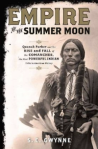 As a student of American Indian history (in the Southeast), I have been asked more than once whether I’ve read this popular book. I’m no expert on the Comanches and only have a general acquaintance with the Great Plains nations. But I do have an in-depth understanding of how challenging it is to write the history of a people whose records were kept by their conquerors. Knowing how much better Indian histories have become in recent years, I came to Empire of the Summer Moon with high hopes. But my first scout through the pages, including a long camp in the bibliography, showed me a history as dead and barren as Ezekiel’s plain of dry bones. Reading the book is like having the ghosts of cavalrymen and settlers rise up to harangue us about the bloody deeds of “wild Indians,” while Indian ghosts remain quiet in their unmarked graves.
This old-fashioned western history pits civilized white people against savage redmen in a bloody contest for control of land. The contest is a racial one and the outcome is inevitable. Because race explains so much, the book dwells with fascination on the “white squaw” Cynthia Ann Parker and her “mixed-blood” son, Quanah. The Comanches as a whole are treated, not as a nation with a history and culture, but as a body of fierce, “primitive” horseback warriors with women and children stowed back at camp under tepees. Because they are so primitive, the Comanches have no history: the way they lived in the 1800s is assumed to be the way they had always lived, and the only way they ever could live.
A good counterpoint to this book would be Comanche author Paul Chaat Smith’s funny and insightful Everything You Know About Indians Is Wrong. It’s too bad Sam Gwynne didn’t have a chance to read it before he embarked on Empire of the Summer Moon. Maybe it would have made a difference. Continue reading “Book review: Empire of the Summer Moon”
Book reviews from LibraryThing
Over the last few years most of my writing online has been on the LibraryThing website, a social niche for book people. LibraryThing’s main product is an easy way to catalog book collections with as much or as little detail as you like. On the social side, it provides book-related local information (on the web […]
Where does the name Waxahatchee come from?

The music press tell us that Waxahatchee is the name of a creek in Alabama. In January 2011 Crutchfield “was living at her parents’ house on Waxahatchee Creek, nursing the bruises of a few bad relationships and wondering what to do with her adulthood.” A severe snowstorm, unusual for Alabama, confined her to the house, and she started writing music: “song after song about loneliness, ambivalence and relationships failing to last or fulfill.” 1
Now there are two albums, American Weekend and Cerulean Salt. She’s playing tonight at Bottletree Café here in Birmingham. So this seems like a perfect time for me to geek out about exactly where the name Waxahatchee comes from, and what it meant.
The name contains a mystery.
Indian names
If you’re one of those people who’s satisfied to hear that Waxahatchee is “an Indian word,” you can stop reading. Go sit under your nylon-stringed dream catcher. If you care to know which Indians, what language they spoke, and so on, then read on. Continue reading “Where does the name Waxahatchee come from?”
Answer: Hate the South
This Friday marks the first anniversary of one of the meanest pieces of writing I’ve seen from a liberal pen. It is Sara Robinson’s piece for Alternet (picked up by Salon) on “conservative Southern values” as an existential threat to our republic. While there’s a glimmer of truth to Robinson’s portrait of what she calls […]
 à la Rob